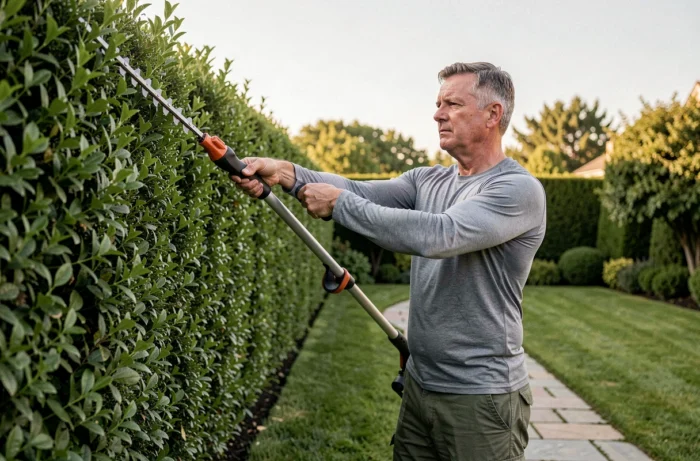
A hedge of thuja that exceeds three meters, a wobbly ladder on a damp lawn, and a classic hedge trimmer held at arm’s length: we’ve all experienced that moment when we think there must be a more suitable tool. The telescopic hedge trimmer solves this problem by keeping both feet on the ground, but not all models are created equal.
Length of the pole, type of motorization, weight in real conditions: the criteria that really matter are not always those highlighted on product sheets.
Stability and visibility of the blade: the true test of a telescopic hedge trimmer
Most guides compare models based on the maximum reach advertised. On paper, reaching four or five meters in height seems sufficient for most residential hedges. In practice, the question changes: at this height, can you still see the blade working?
With the pole fully extended, the center of gravity rises. The tool becomes more difficult to stabilize, and micro-corrections multiply. Field feedback recommends maintaining a margin of at least one meter below the maximum reach to keep proper control. A model advertised at five meters will therefore be comfortable up to about four meters.
The pivoting head helps, but it does not compensate for a poorly distributed weight issue. Before buying, you can test the grip with the pole extended: if the effort in your arms becomes tiring after two minutes, the entire session will be a challenge. A well-designed shoulder harness radically changes the game for long sessions.
To compare models based on these criteria of stability and real maneuverability, the detailed sheets available on taille-haie-telescopique.com allow filtering beyond just the manufacturer’s data.
Battery, corded or gas: choose according to the hedge, not according to trends
The market is heavily pushing towards battery-powered models. For a city garden with a hedge two meters high and ten meters long, this is often the right choice: little noise, no trailing cord, minimal maintenance.
The situation becomes complicated when the hedge is thirty linear meters or when the branches exceed two centimeters in diameter. The actual autonomy of a battery significantly drops under continuous effort, especially on dense wood like laurel or hornbeam. You find yourself halfway through with a dead battery and a hedge only half done.
What each motorization handles best
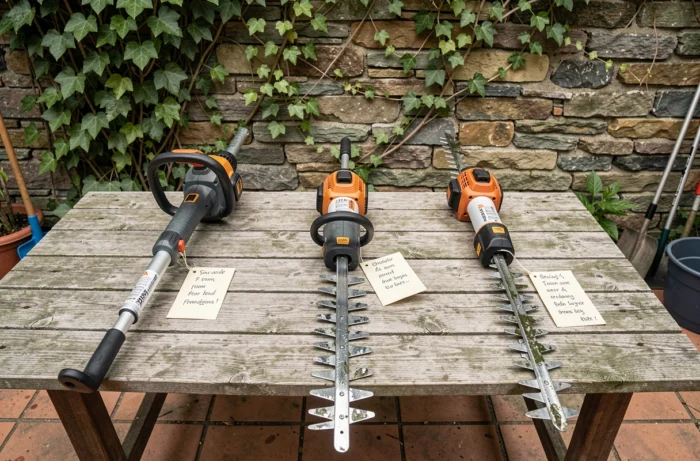
- The battery (lithium-ion) is suitable for short or medium hedges, softwood species (privet, thuja, boxwood), and gardens where noise is an issue. The absence of a cord also makes working at height with the extended pole easier.
- The corded electric model remains relevant when you have an outlet accessible within twenty meters and a dense hedge that requires constant power without interruption. The cord is less of a hindrance than one might think if the hedge runs along a wall.
- The gas model is justified for very long hedges, thick branches, or areas far from any outlet. It is heavier and vibrates more, which becomes a limiting factor on a telescopic tool held at height.
Feedback varies on the actual capacity of batteries to last a full season without losing autonomy. Manufacturers claim several hundred cycles, but wear depends heavily on winter storage conditions.
Blade and tooth spacing: adapting the cut to the type of hedge
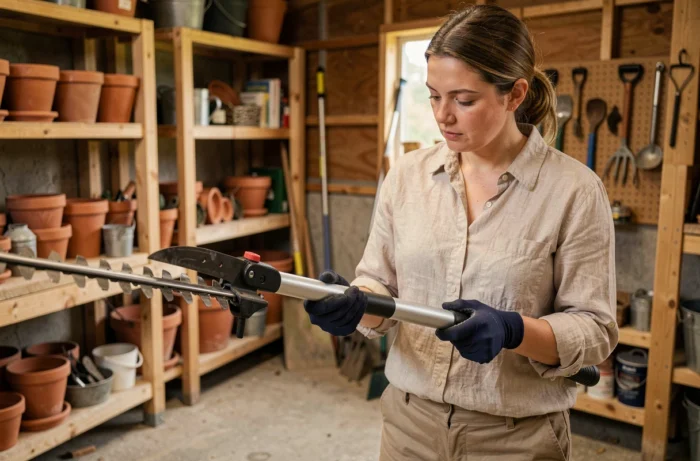
A double-action blade (both blades move in opposite directions) reduces vibrations and provides a cleaner cut. On a telescopic tool, this reduction in vibration matters more than on a classic model because every jolt is amplified by the length of the pole.
The spacing of the teeth determines the diameter of branches that the blade can cut cleanly. A wide spacing can handle thick twigs but lets small shoots slip through. A narrow spacing provides a precise finish but struggles with hard wood. For a mixed hedge, an intermediate spacing of around sixteen to twenty millimeters offers the best compromise.
The length of the blade also plays a practical role. A longer blade covers more surface area with each pass but adds weight to the end of the pole. On a telescopic hedge trimmer, a medium-length blade offers the best coverage/maneuverability ratio for common residential use.
Pruning season and regulations: what comparisons overlook
One rarely chooses a hedge trimmer with the regulatory calendar in mind. Yet it is a parameter that influences the timing of use and the conditions under which the tool operates.
Contrary to popular belief, there is no general national prohibition on trimming a hedge between March and August for individuals. The often-cited restriction concerns agricultural operators subject to CAP rules. However, the destruction of a nest or brood of a protected species remains prohibited year-round, regardless of the trimming date.
The trap comes from local decrees. Some prefectures or municipalities impose additional restriction periods related to ecological issues or noise nuisances. Before planning a major trimming session, checking the rules of your municipality can avoid an unnecessary fine.
Adapting the tool to the season
At the end of summer, the wood is drier and harder: the blade has to work harder. A motorization with sufficient torque and well-spaced teeth makes the job easier. In spring, the tender shoots cut easily, but the sap sticks to the blades, requiring more frequent cleaning. Having a cloth and a lubricating spray on hand reduces premature wear of the blades.
A well-chosen telescopic hedge trimmer is not just about a flattering technical sheet. The actual stability with the pole extended, the motorization suited to the length and type of hedge, the blade spacing calibrated for the species present in the garden: these three criteria, crossed with local calendar constraints, guide you towards the model that will serve for several seasons without frustration.