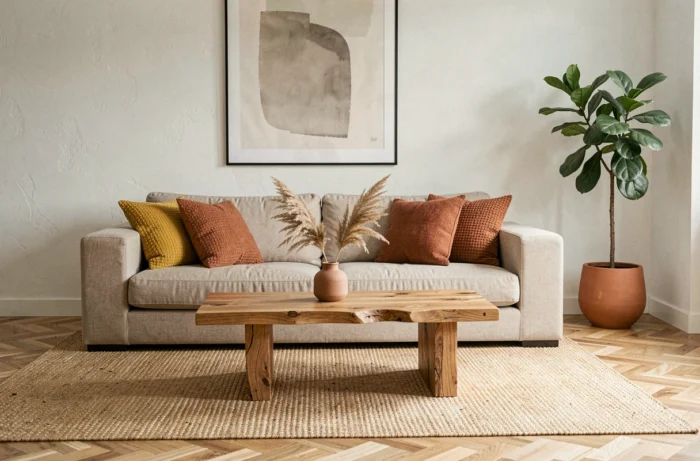
Decor trends evolve quickly, but interiors that age well share a common point: they do not follow a single trend. Transforming your interior with trendy decor today involves crossing several parameters, from materials to finishes, including a criterion rarely addressed in inspiration guides, air quality. The market is shifting towards more contrasting, more personal spaces, where sustainability is no longer limited to the natural appearance of a piece of furniture or a covering.
Indoor air quality: the decor criterion that no one checks
Choosing paint, varnish, or wall coverings for their aesthetics without looking at their emission label is like decorating blindly. In France, since September 1, 2013, construction and decoration products must display a VOC emission label, rated from A+ to C.
This classification covers paints, adhesives, soft flooring, and wall panels. A product rated A+ emits very few volatile organic compounds, while a product rated C can significantly degrade the air in a closed room, especially in bedrooms or poorly ventilated spaces.
Inspiration articles often recommend natural materials (raw wood, linen, terracotta) without ever comparing the emissions of the associated installation products. An adhesive used to fix solid oak flooring may emit more VOCs than the floor itself. For those who wish to delve deeper into the topic of decorative choices and their practical implications, it is possible to learn more about Concept Déco before embarking on a renovation project.
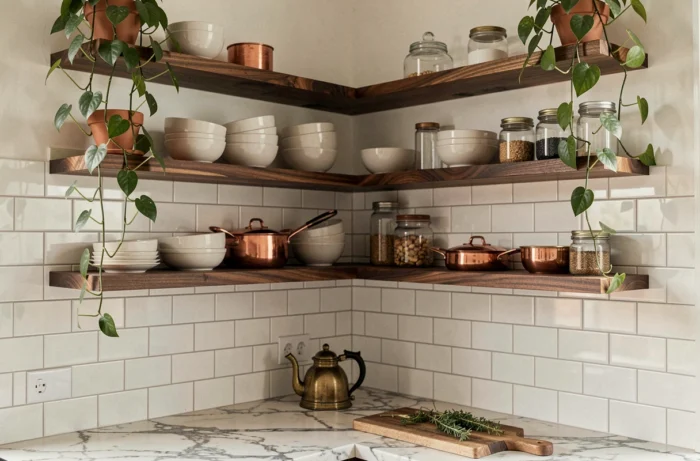
Sustainable materials for interior decor: repairability over appearance
The word “sustainable” has become an almost systematic selling point. In reality, the underlying trend is shifting towards a more concrete criterion: the repairability and disassemblability of decorative elements.
A solid wood piece of furniture can be sanded, re-stained, and repaired. A laminate panel covered with a wood-look film ends up in the landfill as soon as the surface chips. The difference in longevity is considerable, but it never appears in a Pinterest moodboard.
Materials to prioritize for a repairable interior
- Solid wood (walnut, oak, beech) can be restored multiple times throughout its life, provided thick polyurethane finishes that complicate sanding are avoided
- Textiles made from unblended natural fibers (pure linen, pure cotton, wool) are easier to wash, re-dye, and recycle than synthetic blends
- Ceramics and glazed stoneware resist thermal and chemical shocks, and a broken tile can be replaced individually without redoing the entire surface
This logic of repairability changes the way we conceive an interior. Rather than renewing an entire room every five years, we replace or restore worn elements without touching the rest.
Trendy colors in decoration: breaking away from uniform interiors
Earthy palettes, beiges, and greys have dominated interiors in recent years. The market is moving away from this. According to Mon Jardin Ma Maison, designers are now fleeing the “all-beige” decor in favor of more contrasting interiors.
The challenge is no longer to choose a color that is in vogue. It is to avoid the visual uniformity that turns a living room into a hotel showroom. Several trends are emerging for the current season.
Contrasts and depth in wall colors
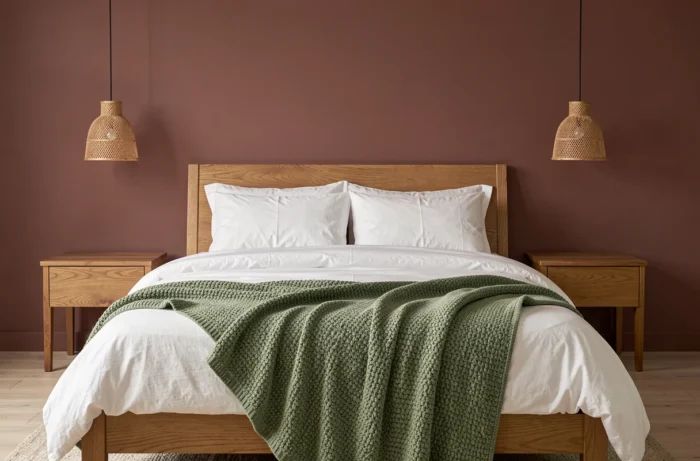
Deep shades (burgundy, wine, chocolate brown) are making a strong comeback, but their use requires a clear counterpoint to avoid overwhelming a space. A dark wall works when the other three remain light, with furniture that creates a bridge between the two registers.
The “collected over time” style, which involves assembling objects and furniture acquired gradually rather than buying a coordinated set, encourages this chromatic diversity. The interior gains personality because it reflects a real accumulation, not a single shopping basket.
Organic shapes and modern furniture: how curved lines change things
Straight lines and sharp angles are receding in contemporary furniture. Organic shapes (rounded seating, tables with softened edges, sculptural lighting) are taking up an increasing space in catalogs.
This evolution is not just aesthetic. A curved sofa changes the flow in a living room: it breaks the rigid geometry of the walls and creates more intimate conversation areas. However, these shapes are more difficult to integrate into small spaces, where a right angle makes better use of every inch.
The return of chrome finishes accompanies this movement. Table legs, handles, lighting fixtures: chrome adds a reflection that contrasts with raw materials (wood, stone, textile). Field reports diverge on this point, with some decorators considering chrome a trend that is already at the end of its cycle, while others see it as a lasting counterpoint to the reign of matte finishes.
Trendy decor and personalization: documenting choices before buying
A successful interior rarely starts with an impulsive purchase. Creating a visual dossier (physical or digital mood board) allows you to test color, material, and volume combinations before committing.
- Photograph each room in natural light and under artificial lighting, as a wall color changes radically between the two
- Gather physical samples of materials (fabric, wood, tiles) rather than relying on screen renderings, which are often misleading about textures
- Note the exact dimensions of the areas to be furnished to avoid scale errors, which are common when buying a piece of furniture seen in a photo in a larger space
Testing materials in real conditions reduces costly mistakes. A paint sample applied to a wall for a few days, observed morning and evening, provides information that a thousand online images cannot replace.
Transforming your interior with trendy decor is not just about replicating a style seen on social media. Choices that stand the test of time combine a personal palette, repairable materials, and concrete attention to what these materials emit into the air we breathe every day.