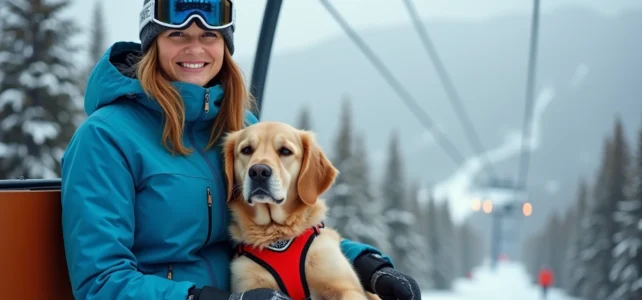
Not all mountain resorts apply the same rules for dogs on ski lifts. Between operators who allow access during off-peak times, those who prohibit it year-round, and those who differentiate between chairlifts, gondolas, and cable cars, the conditions vary on a case-by-case basis. Understanding these discrepancies helps prepare for a trip to high altitudes without unpleasant surprises at boarding.
Chairlift, gondola, and cable car: a comparison of access for dogs
The type of lift often determines the level of tolerance towards animals. Closed gondolas pose fewer safety issues than an open chairlift, where the dog is exposed to the void and the movements of the seat. Cable cars, with their spacious cabins, provide a more stable environment, but access remains subject to the regulations of each operator.
| Type of lift | Available space | Fall risk | Frequent acceptance of dogs |
|---|---|---|---|
| Open chairlift | Shared seat, no enclosure | High | Rare, under strict conditions |
| Closed gondola | Enclosed cabin, flat floor | Low | More common (muzzle often required) |
| Cable car | Large shared cabin | Very low | Variable by resort |
This table reflects a general trend. Each resort sets its own access conditions through its internal regulations. In Saint-Gervais/Megève, for example, the Mont-Joux chairlift prohibits pedestrians and pets, with access reserved for skiers. The possibility of traveling on a chairlift with your dog therefore depends on prior verification with the operator, station by station.
Increasing restrictions at resorts: what is changing for dogs on lifts
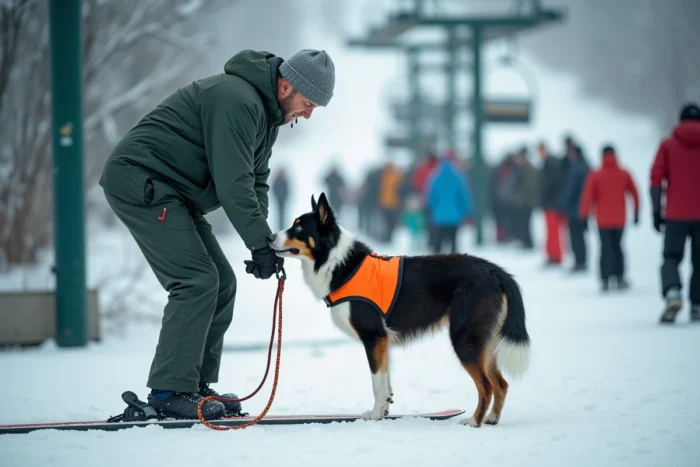
Several resorts are significantly developing their summer activities (bike park, all-terrain scooters, marked hiking). This diversification leads to a restriction of dog access to lifts, including chairlifts used outside the ski season.
The Quebec resort of Val Saint-Côme illustrates this trend: dogs are allowed at the base of the mountain but explicitly prohibited on the ski lifts. In France, resorts that tolerated dogs in summer are beginning to tighten their rules in response to the coexistence with mountain bikers and pedestrians.
This evolution has a direct consequence for dog owners. A chairlift accessible one summer may no longer be the case the following summer. Checking the regulations before each season, and not just before the first trip, becomes a necessary precaution.
Safety equipment for dogs on chairlifts: what works
On an open chairlift, the dog has no enclosed surface to stabilize itself. The main risk is a panic movement at startup, when passing the pylons, or upon arrival when the seat decelerates suddenly.
Harness and attachment point
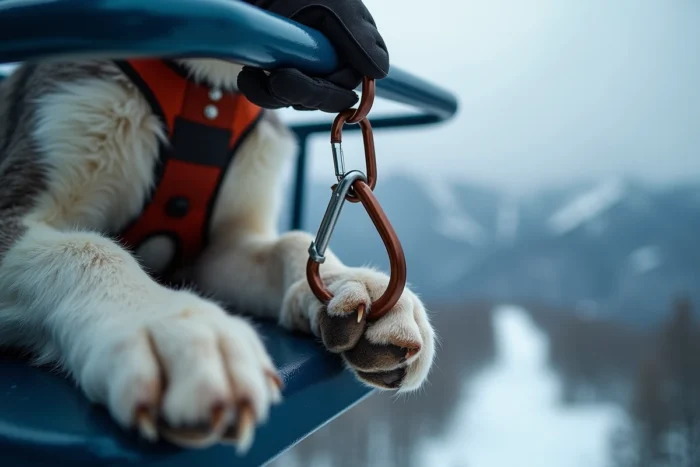
A full harness (chest and back) distributes the tension across the dog’s torso instead of concentrating pressure on the neck like a collar. The carabiner connecting the harness to the safety bar of the seat should be short, so the dog remains on the owner’s lap or between their legs without being able to reach the edge of the seat.
- Harness with dorsal attachment: keeps the dog against the owner’s torso and limits lateral movements
- Short leash (less than an arm’s length): prevents the dog from leaning over the seat without creating permanent tension
- Locking carabiner: prevents accidental opening under tension, unlike a simple spring-loaded carabiner
Muzzle: requirement or precaution
Many resorts that allow dogs on lifts require a muzzle, regardless of the breed. A basket-type muzzle (Baskerville or equivalent) allows the dog to pant and drink, which is important on a high-altitude journey where heat or stress increases breathing frequency. Closed fabric muzzles should be avoided: they prevent panting and can cause rapid overheating.
Acclimatizing the dog to mechanical stimuli before the first ride
A dog that has never heard the sound of a moving cable or felt a sudden acceleration under its paws may panic at the precise moment when stability matters most: boarding and disembarking.
Acclimatization involves gradually exposing the dog to noisy and mechanical environments. Here are some concrete approaches:
- Take the dog near a chairlift departure station (without boarding) so it can acclimate to the sound of the cable and the passing seats
- Have it step onto moving surfaces (walkways, stationary escalators) so it accepts instability under its paws
- Work on recall and immobility in the presence of sound distractions, so the dog remains calm on command
- Consistently reward calmness in these situations, without forcing exposure if the dog shows signs of stress (excessive panting, pinned ears, low tail)
A dog that trembles or tries to flee as it approaches the departure station is not ready. Forcing boarding worsens the phobia and creates a real danger for the animal and other chairlift passengers.
Alternatives to the chairlift for accessing mountain trails with your dog
When the chairlift is prohibited or the dog is not comfortable, several resorts offer hiking trails accessible from the base of the resort. Cross-country ski trails and snowshoe paths, marked and often open to leashed dogs, allow access to viewpoints at altitude without using a lift.
Ski-joering, practiced at some resorts, offers a shared mountain activity between the dog and its owner, with no lift involved. The dog pulls the skier on a groomed trail, which is suitable for medium to large athletic breeds.
The mountains remain accessible with a dog, even without a chairlift. Access to ski lifts is tightening at many resorts, and the applicable regulations may change from season to season. Contacting the lift operator directly a few days before departure remains the only reliable method to avoid a refusal at the foot of the lift.