
Philia focuses the field coordination of the ADMR network into a single interface, but its effectiveness largely depends on how each participant configures and utilizes the functions on a daily basis. Several settings and operational reflexes remain underutilized, even though they reduce friction between the displayed schedule and the reality at home.
Philia ADMR Access Rights: granular settings to limit field errors
The majority of scheduling malfunctions reported by participants stem from poorly calibrated permissions. We recommend configuring participant accounts as read-only on schedules, reserving modification rights for coordinators and sector managers.
This compartmentalization prevents a participant from inadvertently moving a time slot by manipulating the touchscreen of their phone. It also protects sensitive beneficiary data from excessive access.
On the administration side, a quarterly review of active accounts is essential. Profiles of former employees or occasional replacements often remain open for several months after the end of their assignment. Tracking each change in scope in a dedicated register allows for quick responses in case of audits or disputes. To better understand how to use the Philia ADMR software on a daily basis, this rights configuration is the foundation to master before any other optimization.

Time slot modification not validated by the family: Philia workflow to respect
A frequent discrepancy in the field concerns time slot changes initiated by the coordinator but never confirmed by the beneficiary’s relatives. The participant arrives at the home at the new time, but no one opens the door.
Any unconfirmed modification must remain in provisional status in Philia. The coordinator uses a parallel channel (phone call, SMS) to obtain validation, then records the confirmation in the beneficiary’s file notes. As long as this status remains provisional, the participant retains the initial time slot in their planning view.
This workflow reduces unnecessary interventions and tensions with families. It imposes additional discipline on the coordinator, but the traceability obtained protects the entire structure in case of a complaint.
Report an unforeseen event directly from the field
When the participant encounters an unforeseen situation at home (absence of the beneficiary, closed door, deteriorating health condition), Philia allows for adding a timestamped note in the intervention file. We observe that this function remains underutilized: many participants prefer to send an SMS to the coordinator, creating an untracked parallel channel.
The best practice is to enter the note in Philia first, then call the coordinator if the situation requires an immediate decision. The timestamped note is valid in case of a dispute, not the SMS.
Consulting the Philia ADMR schedule offline: tips for white zones
Participants in rural areas regularly encounter network outages between two homes. Philia operates via a web browser, which poses a problem of availability when the mobile connection drops.
- Before leaving the previous home (where the beneficiary’s Wi-Fi is sometimes available), open the planning page and keep it loaded in the browser tab without closing it. The screen remains accessible even without a network as long as the application is not refreshed.
- Capture the weekly planning screen each morning at the start of the day. This capture serves as a backup reference in case of prolonged signal loss.
- Systematically check for planning updates as soon as returning to a covered area, before heading to the next home. A time slot may have changed during the journey.
These reflexes compensate for the lack of a native offline mode. They do not replace an improvement on the publisher’s side, but they prevent delayed interventions due to an outdated schedule.
Digital logbook Philia: quick entry and errors to avoid
The logbook replaces the paper liaison notebook at the beneficiary’s home. Each intervention generates an entry where the participant notes the actions performed, observations, and any anomalies.
The most common error is filling out the logbook at the end of the day, accumulating several interventions. The risk of forgetting or confusing beneficiaries significantly increases. We recommend entering information immediately after each intervention, even if the entry takes only two lines.
What the logbook must contain at a minimum
- The actual start and end times of the intervention (not the theoretical time from the schedule).
- The actions performed, described factually: bathing, meal preparation, accompanying shopping.
- Any unusual observations about the beneficiary’s condition or the home, even if seemingly trivial.
- A clear mention if a planned action could not be performed, along with the reason.
This rigor in entry directly feeds the traceability required by funders (departmental councils, pension funds). A well-documented file in Philia simplifies audits and reduces administrative back-and-forth.
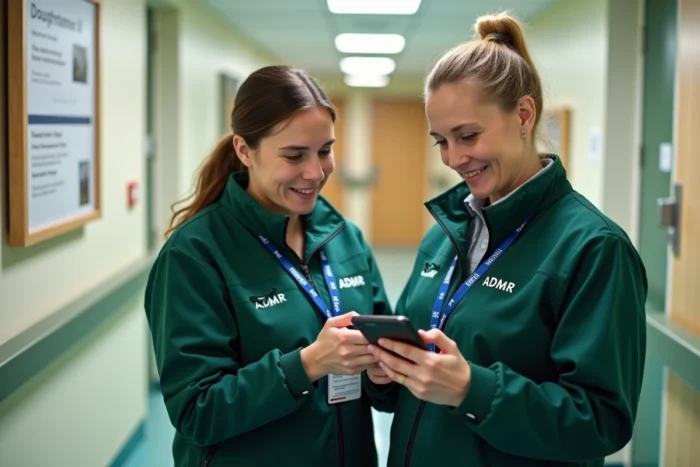
Philia internal messaging and GDPR compliance: abandonment of professional SMS
The messaging integrated into Philia is gradually replacing SMS exchanges between participants and coordinators. This shift responds to a regulatory constraint: SMS messages pass through third-party servers, without guaranteed encryption, and often contain personal data of beneficiaries (name, address, medical condition).
Using Philia messaging for any communication related to an intervention ensures that exchanges remain within the data hosting perimeter of the structure. SMS should only remain for operational emergencies when Philia is inaccessible.
For this change in habit to work, the coordinator must respond via Philia within a timeframe comparable to SMS. If the internal messaging becomes a slow channel, participants will naturally revert to SMS, nullifying the GDPR benefit.
The complete transition to Philia messaging requires a collective commitment from the structure, not just an individual directive. Associations that have implemented it have observed a reduction in disputes related to the transmission of sensitive information through unsecured channels.