
Amber is one of those names that is spontaneously associated with a warm color and a noble material. Behind this soft sound lies an etymology that is less obvious than it seems, and a trajectory in France that deserves attention. This feminine name, now among the most given to girls, carries within it several layers of meaning related to fossilized resin, Arabic perfumery, and Christian tradition.
Gray amber and yellow amber: two materials, one name
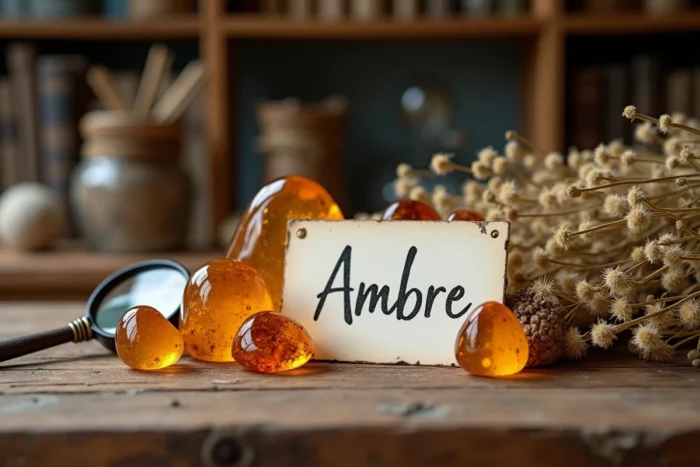
The word “amber” refers to two very different substances. Yellow amber is a fossilized resin, hardened over millions of years, found on the coasts of the Baltic or Mediterranean. Gray amber, on the other hand, is a secretion produced by the sperm whale, long used in perfumery.
The name Amber originates from the Arabic word anbar, which refers to gray amber. This material was so precious in the medieval Arab world that it gave its name to a color, and then to a name. In parallel, the golden resin has fueled European imagination: the Greeks called it “êlektron,” a word that led to “electricity” because rubbed amber attracts small objects.
To delve deeper into the meaning and origin of the name Amber, one must keep in mind this dual lineage: Eastern through the direct etymology, European through the imagination linked to the precious stone.
A third avenue exists. Some sources link Amber to the name Ambrose, derived from the Greek “a-brotos,” meaning “immortal.” This connection explains why the feast of Amber is set on December 7, the day of Saint Ambrose. Saint Ambrose, Bishop of Milan in the 4th century, remains a major figure in the Catholic Church.
Name Amber in France: a rapid rise followed by a plateau
Amber was virtually absent from the French civil registry before the 1980s. The name began to appear very discreetly, then saw a clear increase starting in the 2000s.
Are you wondering where its popularity stands today? Recent data from INSEE places it on the podium of female names. In 2024, 2,815 baby girls were given the name Amber. In 2025, this number drops slightly to 2,805, a very slight decrease that places Amber in third position behind Louise and Jade.
This stabilization after a strong rise is a classic pattern. A name rises for about fifteen years, reaches a plateau, and then sometimes begins a slow decline. Amber seems to have reached this high plateau, with minimal annual variations.
Regional disparities to be aware of
The popularity of Amber is not uniform across the territory. The departmental rankings published by INSEE show that this name is in the top 10 of most departments, but with significant rank differences depending on the regions. In Picardy, for example, short and sweet names like Amber have a particularly strong appeal.
Amber, a “nature” name: a trend that goes beyond mere aesthetic taste
Online competitors generally categorize Amber in the “character” or “astrology” sections. What is rarely analyzed is why this name took off precisely at the turn of the 2000s.
Amber fits into a wave of nature and mineral-inspired names: Jade, Opal, Rose, Gaia. These names are not chosen at random. They reflect a parental sensitivity oriented towards authenticity, simplicity, and sometimes a conscious ecological approach.
Specialized name trend websites describe Amber as a name that appeals to families sensitive to environmental and artistic themes. The choice is not only phonetic: it carries a symbolic value linked to raw material, long time (fossilized resin), and golden light.
This framework explains why Amber coexists so well in the rankings with Jade. The two names share:
- A direct reference to a stone or natural material, immediately identifiable
- A short sound, one or two syllables, easy to pronounce in several languages
- A connotation of warmth and softness, without a marked religious dimension
Variants and names close to Amber
The name has several variations depending on languages and registers. Amber is the English form, widely used in Anglo-Saxon countries. There is also Ambra in Italian, or even compound names like Amber-Rose or Marie-Amber, which are rarer in France.
Among names close in sound or universe, we can mention:
- Jade, the most attributed “mineral” name in France, often in first or second position
- Opal, much more confidential, which falls within the same category of precious stones
- Ambrose, the historical masculine name from which Amber partly derives, borne by a few hundred boys each year
- Anaïs or Agathe, short two-syllable names that share a similar aesthetic without the link to nature
Personality associated with the name Amber: what traditions say
Numerology links Amber to the number 6, associated with family harmony and a sense of responsibility. In symbolic astrology, the sign of Leo is often mentioned. These attributions fall under interpretative traditions, not scientific data.
The character descriptions most often mention a warm, communicative personality with a marked sensitivity. Amber is described as a frank person, sometimes so direct as to surprise, but fundamentally kind-hearted.
Among the personalities bearing this name, we can cite Ambre Nguyen or Ambre Larrazet, known in French media. The name also appears in fiction, notably with the character Amber Moore in the series “The Young and the Restless.”
The name Amber has thus achieved quite a remarkable journey in France: starting from zero in the 1980s, it has firmly established itself in the top trio of female names. Its dual etymology, Arabic and Greek, gives it a richness that its brevity does not suggest. Its current stability on the podium suggests that it will remain popular for several more years, driven by the wave of natural names that shows no signs of waning.