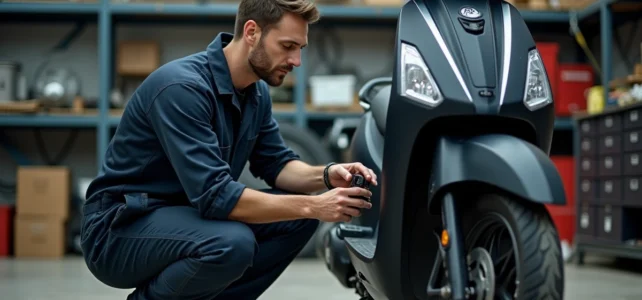
A scooter that stutters during acceleration rarely indicates a single failure. The symptom encompasses very different mechanical realities depending on whether the two-wheeler is thermal or electric, equipped with a carburetor or fuel injection, and whether it has a new or worn variator. The most commonly cited causes (spark plug, air filter, fuel) represent only part of the diagnosis.
The gradual implementation of the two-wheeler technical inspection in France adds a regulatory dimension that most online guides still overlook.
Transmission and variator: the cause of stuttering that guides neglect
The majority of available content immediately points to the carburetor or the spark plug. However, field reports show that, on modern scooters with a variator, a worn or glazed belt causes stuttering during acceleration that has nothing to do with the fuel supply. The engine runs correctly at idle, but the transmission no longer converts power linearly.
The variator rollers wear down by flattening. When their profile is no longer round, shifting from one gear to another (on a continuously variable variator) occurs in jolts. The scooter stutters at mid-rev, then resumes normally at high revs once the rollers are pressed into the final position. This pattern is characteristic and allows for distinguishing a transmission problem from an engine problem.
Identifying acceleration problems in scooters related to the variator requires checking three elements simultaneously: the condition of the belt (cracks, residual width, signs of glazing), the weight and shape of the rollers, and the tension of the drive spring. A poor combination of springs, even on new parts, is enough to create persistent stuttering.

Carburetor, injection, and fuel quality: distinguishing symptoms
On a carbureted scooter, stuttering at low revs often points to a clogged jet or an improper air-fuel mixture adjustment. The mixture screw controls the air-fuel mixture at idle and during transitional phases. A quarter turn too much, in either direction, significantly alters the acceleration behavior.
The type of fuel also plays a concrete role. Some ethanol-based blends (notably SP95-E10) can cause acceleration difficulties on older engines whose gaskets and carburetor membranes are not compatible. The tank then accumulates moisture, and the engine receives a diluted mixture intermittently.
On electronically injected scooters, the diagnosis changes. Stuttering more often comes from a faulty sensor (lambda probe, throttle position sensor) than from a mechanical fuel supply problem. The loss of acceleration sometimes manifests only when hot, when the ECU corrects the mixture based on erroneous information. Without a diagnostic tool, locating the fault on an injected scooter remains difficult for an individual.
Spark plug and ignition: a quick but incomplete diagnosis
A dirty spark plug or one with electrode gaps out of tolerance causes visible misfires in the form of stuttering. Replacement is inexpensive and takes a few minutes, making it the first logical reflex. However, if the stuttering persists after changing the spark plug, the problem lies upstream (coil, suppressor, wiring).
Electric scooter: specific causes of loss of acceleration
In recent years, reports of acceleration problems on electric scooters (urban and PMR models) have increased. The causes have nothing in common with a thermal engine:
- Aging battery: a failing cell in the pack limits the available current and causes abrupt cuts when power is demanded
- Overheating or error in the electronic controller: the scooter limits acceleration for safety, without any visible signal for the user
- Brake sensor stuck in the active position: the system interprets a constant braking and cuts power as soon as the throttle is turned
- Software error requiring a manufacturer reset, with procedures specific to each brand
The diagnosis on an electric scooter first involves reading error codes via the dashboard screen or a dedicated app. Field reports vary on the reliability of these self-diagnostics: some models display a precise code, while others only show a generic warning light that does not allow for conclusions.

Two-wheeler technical inspection and stuttering: what changes from 2026
The motorcycle and scooter technical inspection, gradually implemented between 2024 and 2026 in France, requires documented verification of the condition of the transmission, braking system, and emissions. Scooters registered between 2020 and 2021 will enter the system in 2026.
A stuttering related to a worn variator belt, a perforated exhaust, or an engine whose emissions exceed thresholds could become a reason for a re-inspection. Acceleration problems are no longer just a driving inconvenience: they may potentially be disqualifying during the inspection.
This regulatory dimension changes the logic of maintenance. Delaying the replacement of a belt or ignoring intermittent stuttering now exposes one to a refusal of inspection validation, with an obligation for repair and re-inspection within a specified timeframe.
Elimination diagnostic method for a stuttering scooter
Rather than replacing parts at random, a sequential approach limits unnecessary expenses:
- Observe the rev range at which the stuttering occurs: low revs only (likely fuel supply), mid-revs (likely transmission), throughout the range (likely ignition or injection)
- Check the condition of the spark plug and air filter, both accessible without specific tools
- Visually inspect the belt and rollers if the stuttering occurs only during gradual acceleration
- On an injected model, connect a diagnostic tool before any mechanical disassembly
The engine revs at which the symptom manifests remain the first reliable indicator to guide the diagnosis. Constant stuttering across the entire rev range does not point to the same fault as a localized jolt between idle and mid-rev.
A thermal scooter whose routine maintenance (spark plug, filter, belt, rollers) is up to date and still stutters requires a visit to a workshop for electronic diagnosis or compression testing. Continuing to change consumables without results ultimately costs more than a professional diagnosis.