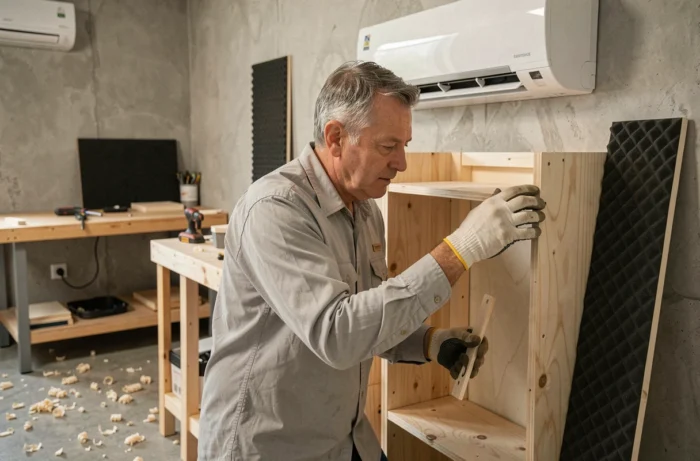
The outdoor unit of a split air conditioner generates a noise level between 25 and 50 decibels depending on the models, sometimes even more on aging devices. Since April 2024, law n° 2024-346 has introduced article 1253 into the Civil Code, which establishes a strict liability for any disturbance exceeding the normal inconveniences of neighborhood. Air conditioners and heat pumps are explicitly targeted.
Building an acoustic enclosure around the outdoor unit then becomes both a legal precaution and a comfort choice.
Legal risk related to noise from an outdoor air conditioning unit
Noise reduction enclosure tutorials focus on materials and dimensions, rarely on the primary reason for taking action. Article R.1336-5 of the Public Health Code regulates neighborhood noise and now aligns with article 1253 of the Civil Code.
In practical terms, a neighbor no longer needs to prove fault to hold the air conditioning owner liable. The mere observation of an abnormal disturbance is sufficient. A properly sized acoustic enclosure serves as proof of good faith and a recognized technical measure to bring noise emissions below regulatory thresholds.
In a co-ownership situation, things become more complicated: the regulations may impose aesthetic constraints or prohibit certain installations on facades. Before installing any panel, checking the clauses of the co-ownership regulations and, if necessary, obtaining the agreement of the general assembly can prevent costly setbacks.
Those who wish to build an acoustic enclosure for air conditioning should integrate this legal dimension from the design phase, rather than having to modify the structure after a complaint.
Physical principles of an acoustic enclosure for air conditioning
An acoustic enclosure does not function like a simple casing. Three mechanisms come into play, and neglecting them makes the project ineffective, or even dangerous for the device.
Mass, absorption, and vibrational decoupling
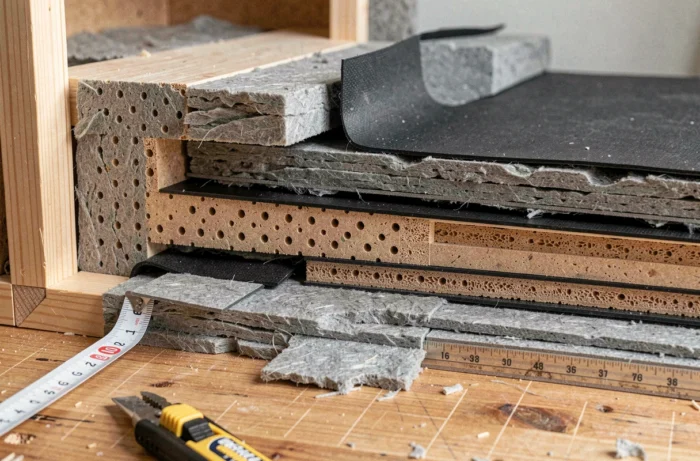
The mass of the walls blocks the direct transmission of sound. The heavier the panel, the more it attenuates low frequencies, such as those from the compressor. 19 mm MDF or plywood offers a good weight/handling compromise.
Absorption occurs inside the enclosure. A honeycomb acoustic foam or rock wool lined on the internal walls captures sound reflections and prevents resonance. Without this treatment, the enclosure amplifies certain frequencies instead of attenuating them.
Vibrational decoupling is the most often overlooked point. The enclosure must never be in rigid contact with the outdoor unit. Rubber mounts or neoprene strips between the floor and the base of the enclosure absorb the mechanical vibrations transmitted by the compressor. Without decoupling, vibrations propagate through the structure and the adjacent wall.
Enclosure ventilation: the main trap
An outdoor air conditioner expels hot air and draws in cool air. Blocking the airflow reduces performance and can cause the compressor to overheat, leading to excessive energy consumption and premature wear.
The basic rule: leave a free space of at least the width of a hand between each face of the unit and the inner wall of the enclosure. Ventilation openings should be placed in a zigzag pattern, never in a straight line facing the air conditioner’s grille. This zigzag path forces sound waves to bounce off the absorbing walls while allowing air to circulate.
- Provide an air intake at the bottom and an outlet at the top to promote natural convection
- Orient the openings away from neighboring windows to deflect the sound propagation line
- Line the internal zigzags with the same absorbing material as the walls
- Check that the airflow is not reduced by placing a hand in front of the air conditioner’s outlet after installation
Choice of materials and assembly of the acoustic enclosure
The choice of materials directly determines the level of sound attenuation. Two approaches coexist, with very different results.
Rigid structure in wood or composite
19 mm MDF remains the most commonly used material in DIY acoustic enclosure projects. It is dense, easy to cut, and available at hardware stores. Marine plywood is more resistant to moisture, a criterion to consider for equipment exposed to the elements.
The sealing of joints is more crucial than the thickness of the panels. An air leak, even a small one, allows sound to pass through. Acoustic silicone sealant on each joint and regularly spaced screws ensure airtightness. Field feedback varies on the usefulness of a double wall: it increases mass but complicates access for maintenance.
Internal absorbing lining
Honeycomb polyurethane foam (pyramid type) combined with a heavy vinyl mass underlayment forms the most effective duo for a reasonable budget. The foam absorbs mid and high frequencies, while the heavy mass blocks the lows.
- 25 to 50 mm thick honeycomb acoustic foam, glued to all internal walls
- Heavy vinyl mass underlayment between the wood panel and the foam
- Neoprene adhesive to fix the foam (no through screws that create acoustic bridges)
Maintenance and durability of a noise-reducing air conditioning enclosure
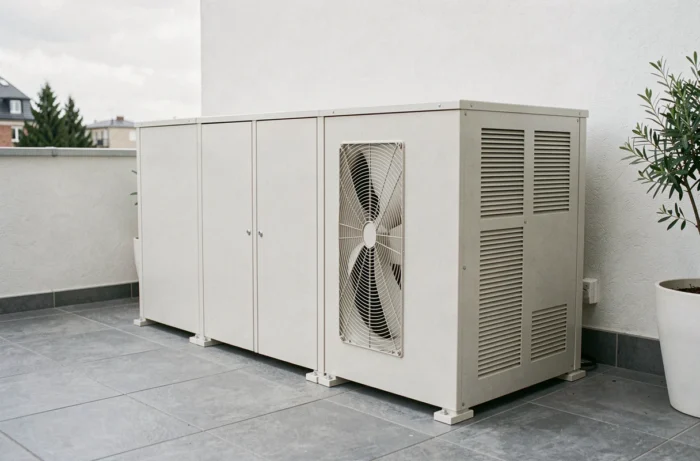
A closed enclosure that does not allow access to the outdoor unit without complete disassembly ends up abandoned or removed at the first maintenance. Planning for a removable panel on the access side to the filters and refrigerant connections is a design constraint, not an option.
Absorbing materials exposed to moisture and UV degrade. Unprotected polyurethane foam loses its properties in a few seasons. A waterproof treatment on the external face of the wood and a UV varnish on exposed parts extend the lifespan of the structure. Checking the condition of the foam and seals annually helps maintain the initial level of attenuation.
The issue of the air conditioner’s manufacturer warranty deserves attention. Some manufacturers exclude damage related to ventilation failure caused by third-party coverings. Keeping a record of the enclosure design (dimensions, ventilation spaces, materials) can be useful in case of disputes with the manufacturer or installer.
A well-designed enclosure significantly reduces the noise perceived by the neighborhood, legally protects the owner, and preserves the performance of the device. The challenge lies not in the construction itself, but in balancing sound insulation and airflow, a compromise that each configuration requires recalculating.