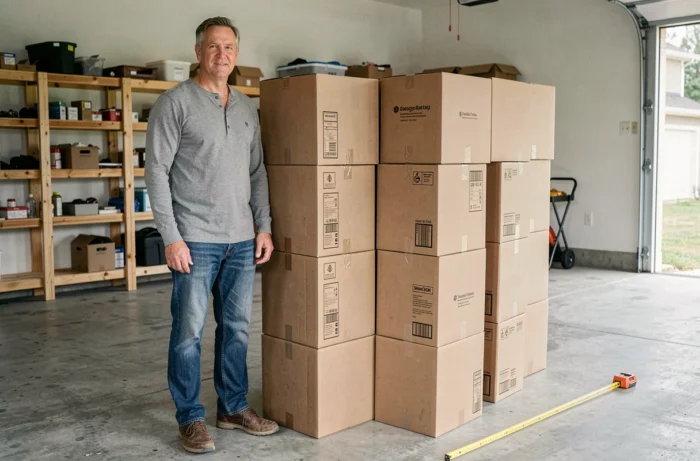
A cube with a side of one meter is easy to imagine. Three of these cubes lined up is already more vague. When a moving quote, a storage box, or a rental contract mentions 3 cubic meters, most people nod without really knowing what that corresponds to. Visualizing a volume in space requires concrete references, not a mathematical formula.
The volume of 3 m³ in relation to decent housing standards
Before talking about boxes and furniture, a detour through regulations helps to situate the scale. Decree No. 2002-120 requires that a main room offers a habitable volume of at least 20 m³ to be considered decent. In other words, 3 m³ represents about 15% of this minimum threshold.
Imagine your bathroom. In a standard apartment, it rarely occupies more than 4 or 5 m². With a typical ceiling height, its volume often hovers around 10 m³. So, three cubic meters is less than a third of this small room.
This regulatory benchmark anchors the measurement in something tangible. It also helps to understand what 3 cubic meters represent when filling a storage space or a utility vehicle: it’s a real volume, but limited.
Everyday objects that total 3 cubic meters
Abstract numbers become clear as soon as they are translated into familiar objects. Here are some combinations that approach 3 m³:
- A two-seater sofa, a coffee table, and two or three standard moving boxes roughly fill this volume.
- A standard combined refrigerator (about 0.5 to 0.7 m³) combined with a washing machine and a few bags of clothes reaches the same range.
- About thirty standard moving boxes (book size, around 50 liters each) stacked occupy a comparable space.
A two-seater sofa alone fills nearly a third of the total volume. This is often the surprise during a move: a single piece of furniture can consume a significant portion of the available cubic space.
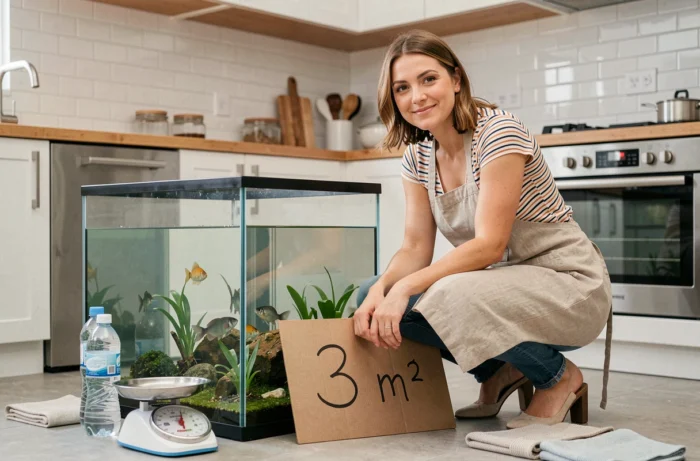
Simple geometric shapes to visualize 3 m³
The basic calculation remains useful for visualizing the volume in a real space. 3 m³ corresponds to a block that is 1 m wide, 1 m high, and 3 m long. This is roughly the length of a three-seater sofa placed on the floor, with a meter in height and a meter in depth.
You can also think of a cube with each side measuring about 1.44 m, which is roughly the size of a large low wardrobe. No calculator needed: remember that a standard entrance hallway, at one meter deep and one meter high, represents this volume along its entire length.
The trap of irregular shapes
A bicycle, a vacuum cleaner, or a garden chair do not stack like bricks. The gaps between objects can account for a quarter of the occupied volume. When loading a car trunk or a storage box, irregular shapes inflate the used space without adding weight.
To correct this bias, a simple rule works: measure each object as if it were a rectangle (maximum length, width, height), then add about 20% to the total. This margin compensates for the lost spaces between objects.
Concrete situations where 3 m³ make a difference
Have you ever rented a utility vehicle for a small move? A 3 m³ van corresponds to the smallest utility vehicle offered by rental companies, like the Renault Kangoo or Citroën Berlingo in the long version. It is the format suitable for a furnished studio with few personal effects, or for emptying a modest-sized cellar.
For storage in a storage unit, 3 m³ boxes are often the smallest available. They are suitable for the contents of a single room: a student bedroom or a home office, for example.
Comparison with the water in a pool
If you fill a container of 3 m³ with water, you get exactly 3,000 liters. For pool owners, this figure is significant: it’s the amount of water needed to fill a small garden pool of about 2 m long, 1.5 m wide, and 1 m deep. 3,000 liters of water weigh 3 tons, giving an idea of the mass that this volume can represent depending on the material.
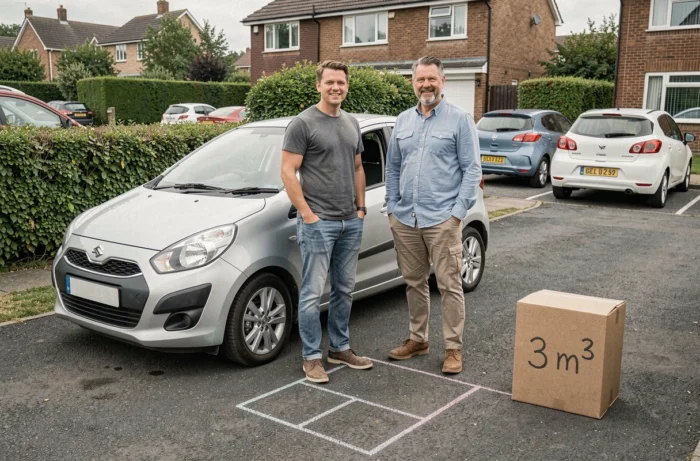
Quick method to estimate a volume in cubic meters without tools
No tape measure on hand? Two tricks allow you to estimate a volume without precise measurement.
The first: use your arms. An average adult, with arms outstretched, covers about 1.70 m in wingspan. With this body reference, you can estimate the length and width of a pile of objects on the ground. Height can be easily gauged against your height.
The second: count the boxes. A standard moving box is about 50 liters, or 0.05 m³. By dividing 3 m³ by 0.05, you get 60 boxes. If your pile of belongings significantly exceeds this number, you are beyond 3 m³.
- Measure in steps (a large step is about 0.75 m) to estimate the length on the ground.
- Compare the height of your pile to a fixed reference: a standard door measures about 2 m.
- Multiply estimated length, width, and height to get an approximate cubic measurement.
These estimates remain rough, but they are sufficient to choose the size of a utility vehicle or confirm that a storage box will be suitable.
The volume of 3 m³ remains a modest format, suitable for small projects: moving a bedroom, emptying a cellar, temporary storage. Keeping in mind that a two-seater sofa already occupies a good third of it, you will avoid the unpleasant surprise of a truck that is too small or a box that is too tight.