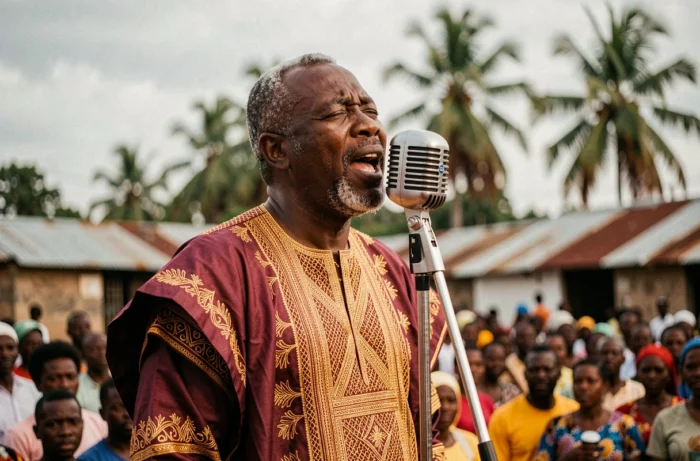
When listening to a Congolese rumba playlist in a bar in Kinshasa or Brussels, the voice of Papa Wemba always seems to emerge. Not as a frozen memory, but as a presence that still shapes the way we perceive this music.
Born Jules Shungu Wembadio Pene Kikumba in Lubefu in 1949, he traversed more than four decades of career redefining rumba and soukouss, until his fatal collapse on stage in Abidjan on April 24, 2016.
The passage through Zaiko Langa Langa and the birth of a vocal style
One cannot understand the sound of Papa Wemba without going back to his time in Zaiko Langa Langa, the orchestra that shook up Congolese rumba in the late 1960s. It was there that he forged his singing technique, a high and fluid register that contrasted with the dominant deep voices of the time.
What distinguished his voice was his ability to switch between spoken register and lyrical flights within the same piece. He was not seeking raw power. He worked on nuances, the silences between phrases, an approach closer to that of a storyteller than a pop singer.
After Zaiko, he founded Viva La Musica, an orchestra designed as a true training school. We will return to this, but this transition from salaried musician to conductor-trainer changed the game for an entire generation of Congolese artists. Detailed resources on this entire trajectory are available at papawemba.fr, which traces the significant stages of his career.
Viva La Musica: a school of Congolese rumba more than just an orchestra
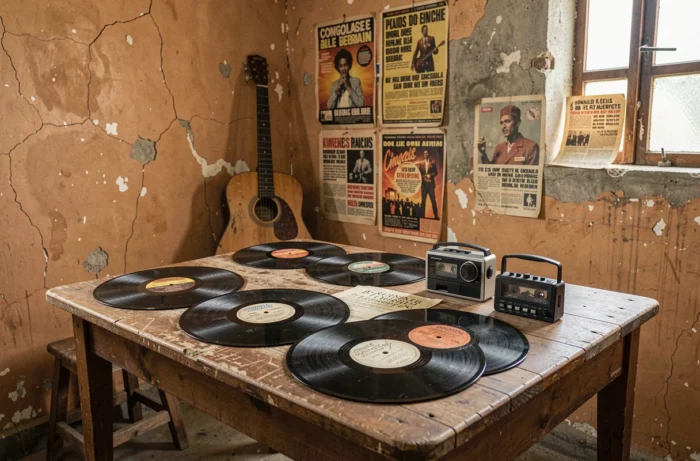
Viva La Musica was not just a band. It was an integrated musical transmission system, where young recruits learned the repertoire, stage presence, discipline, and fashion style all at once.
Dozens of artists passed through Viva La Musica before embarking on their own careers. The functioning resembled that of an apprenticeship: one entered as an accompanist, progressed through tours, and eventually ended up being presented as a soloist during concerts.
Papa Wemba led rehearsals with a demand that went beyond musical accuracy. He imposed a strict dress code, a precise stage attitude, and a form of artistic loyalty. Reactions vary on this point, with some former members recalling a formative rigor, while others mention a sometimes stifling discipline.
A repertoire that blended tradition and experimentation
The catalog of Viva La Musica spans several decades and various stylistic turns. The early years remained rooted in pure rumba, with dry guitars, clave rhythms, and choirs in Lingala. Later, Papa Wemba incorporated elements of Western pop, French variety, and even world music, especially during his collaborations with producers based in Paris.
This blend did not always win unanimous support in Kinshasa. Some of the audience criticized Papa Wemba for diluting rumba to appeal to the European market. Others saw it as proof of his international ambition. This tension between fidelity to soukouss and global openness structured the entire second half of his career.
The SAPE as an extension of Congolese musical identity
One cannot speak of Papa Wemba without addressing the Société des Ambianceurs et des Personnes Élégantes. He did not invent the SAPE, but he became its most visible face on the international stage, to the point that the movement and the artist became inseparable in the collective imagination.
What is less known is that the elegance of clothing functioned as a complete stage language. On stage, changing costumes between two pieces was not a whim. It was a marker of musical transition, a way to signal to the audience that one was moving from one emotional register to another.
- The European three-piece suit, worn with Weston shoes, marked the slow rumba pieces and ballads.
- More colorful outfits and extravagant accessories accompanied the fast and danceable soukouss tracks.
- Traditional Congolese clothing appeared during pieces with spiritual or memorial dimensions, often sung in the Tetela dialect.
This clothing codification has influenced how Congolese artists still conceive their stage presence.
The Rumba Museum in Kinshasa: a legacy between memory and fragility
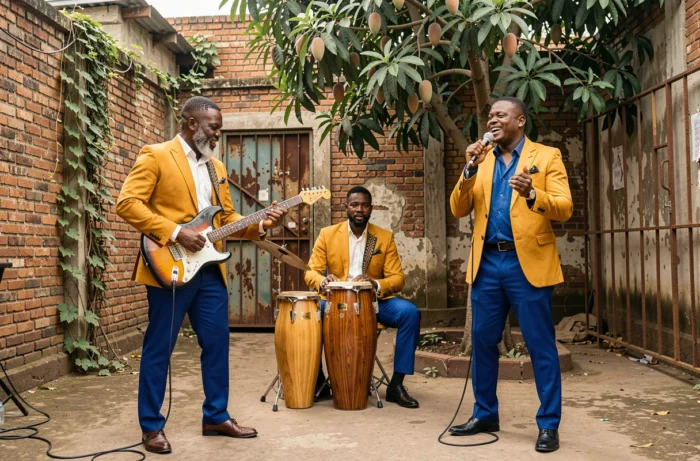
Papa Wemba’s house in Kinshasa has been transformed into a national rumba museum, open to the public. It houses pieces from his sapeur wardrobe, instruments, and visual archives. The place organizes guided tours, conferences, and occasional concerts.
The project carries a strong ambition, but attendance remains modest: the museum currently attracts only about a hundred visitors, which fuels a local debate about the risk of gradual forgetting of Congolese rumba. The question goes beyond Papa Wemba: it touches on the ability of Congolese institutions to transform a living musical heritage into sustainable cultural infrastructure.
An inheritance dispute that reveals family tensions
Alongside the museum, an inheritance dispute remains open regarding Papa Wemba’s legacy. The case mainly concerns the recognition of children born out of wedlock. The legal wife, Marie-Rose Luzolo, mentions six children, while a collective claims that the sibling group is much larger.
This conflict illustrates a frequent reality in the DRC, where family law and customary practices do not always align. It also shows that the memory of an artist is not only played out in the musical field, but also in courts and civil registries.
Papa Wemba’s legacy lies in this duality: on one side, a voice and a style that continue to nourish African music and the diaspora, from Paris to Kinshasa. On the other, a material and familial heritage still in the process of stabilization, with a museum seeking its audience and an unresolved succession.