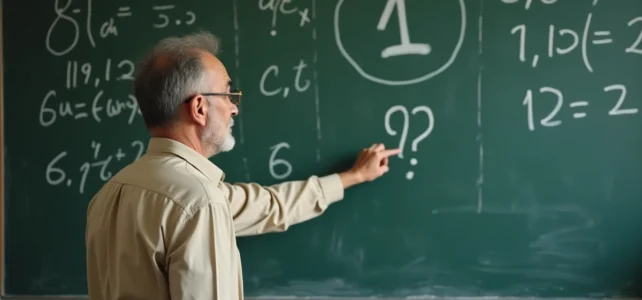
The answer is clear: 1 is not a prime number. The modern definition requires that a natural integer be strictly greater than 1 and have exactly two distinct positive divisors. The number 1 has only one divisor (itself), which excludes it from the category. This convention is not a whim of notation; it protects a fundamental theorem of arithmetic.
Uniqueness of Prime Factorization and the Status of 1
The fundamental theorem of arithmetic guarantees that every integer greater than 1 can be uniquely factored into a product of prime numbers, disregarding the order of the factors. If 1 were considered prime, this uniqueness would immediately collapse.
Take 12. Its factorization is 2 × 2 × 3. If 1 were among the primes, we could write 1 × 2 × 2 × 3, or 1 × 1 × 2 × 2 × 3, and so on infinitely. The uniqueness of factorization disappears as soon as 1 enters the list.
The question of whether 1 is a prime number thus finds its answer in this structural requirement. Excluding 1 is not an arbitrary decision: it is the necessary condition for prime factorization to remain a reliable tool in number theory, cryptography, and algebra.

Divisors of 1: Why the School Definition Misleads
The classical dictionary formulation presents a prime number as an integer “divisible only by itself and by 1.” This phrase implicitly assumes that “itself” and “1” refer to two distinct integers. For any prime number (2, 3, 5, 7, 13…), this is indeed the case.
For the number 1, the two terms coincide. It has only one positive divisor. A prime number has exactly two distinct positive divisors, not one, not three or more. The number 1, with its unique divisor, does not meet this criterion.
Recent educational resources, whether French-speaking, German-speaking, or Portuguese-speaking, have incorporated this clarification. The adopted formulation is now systematically “natural integer strictly greater than 1.” Online primality calculators apply a preliminary filtering rule: if the input is 0, 1, or a negative integer, the result is “not prime” even before running a test algorithm.
Algebraic Status of 1: Unit, Prime, Composite
In algebra, integers are classified into three mutually exclusive categories (beyond 0):
- Units: Invertible elements in the ring of integers. In the integers, only 1 and -1 are units, as they are the only integers whose product yields 1.
- Prime numbers (or irreducibles in a ring): Integers greater than 1 whose only positive divisors are 1 and themselves. For example, 2, 3, 5, 7, 11.
- Composite numbers: Integers greater than 1 that have at least one divisor other than 1 and themselves. For example, 4, 6, 8, 9, 10.
The number 1 belongs neither to the primes nor to the composites. It forms its own category: that of units. This distinction is far from cosmetic. In more general algebraic structures (rings of integers of number fields, polynomial rings), the separation between units and irreducible elements conditions the functioning of factorization.
Why Mathematicians Have Changed Convention Over Time
The question has not always reached consensus. Several 19th-century mathematicians considered 1 to be prime. Prime number tables published at that time sometimes included 1 at the top of the list.
The shift occurred gradually as number theory gained formal rigor. The exclusion of 1 simplifies the statement of dozens of theorems. Without this convention, every result concerning prime numbers would need to add a clause “except 1” or “for p greater than or equal to 2.” The current convention eliminates this systematic noise.
We observe the same phenomenon in other areas of mathematics: a definition evolves when it makes statements cleaner and proofs smoother. The choice to exclude 1 from the primes is not an ontological truth set in stone; it is an optimal convention for the theoretical framework as it exists.
Practical Consequences in Cryptography and Algorithms
Asymmetric cryptography algorithms rely on the difficulty of factoring large integers into products of prime numbers. If 1 were prime, the very notion of “unique factorization” would lose its meaning, and these protocols would lose their mathematical foundation.
Primality tests implemented in common programming languages all start with a trivial filter: any integer less than or equal to 1 is rejected before any calculation. This is not an implementation choice; it is the direct translation of the mathematical definition into code.
The consistency between the theoretical definition and its computational application reinforces the consensus. No serious cryptographic library treats 1 as an ambiguous case.
The debate over the status of 1 remains an excellent pedagogical exercise for understanding how mathematics constructs its definitions. The answer, however, is no longer ambiguous: 1 is a unit, not a prime number, and this distinction protects the coherence of results used daily in both pure and applied mathematics.