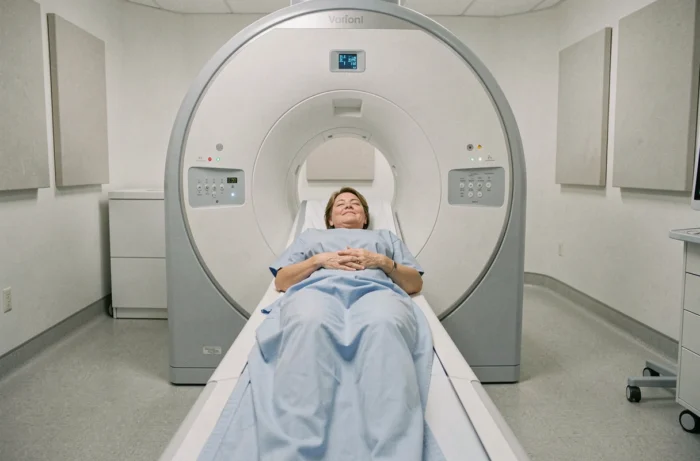
The open MRI refers to an imaging device that uses magnetic resonance imaging where the magnet does not form a closed cylindrical tunnel but leaves at least two sides open. For patients suffering from claustrophobia, this configuration radically changes the experience of the examination. Feedback from patients shows that the difference between a truly open device and a simply enlarged device is not always understood until the day of the appointment, which sometimes leads to disappointment.
Open MRI or wide-bore: a common confusion among claustrophobic patients
Many imaging centers offer so-called “wide-bore” machines, presenting them as a solution for claustrophobics. The diameter of the tunnel is indeed larger than that of a standard machine, which reduces the feeling of confinement. However, the patient remains lying in a closed cylinder at both ends.
A wide-bore machine is not an open MRI. The distinction is technical: the open-field MRI uses a C-shaped or plate-shaped magnet, leaving the patient visible and accessible from the sides. The wide-bore MRI maintains the tunnel architecture, simply enlarged by a few centimeters.
Testimonials collected on patient forums reveal that this nuance is often discovered on the day of the examination. Some patients thought they had made an appointment for an open MRI and find themselves facing a tunnel that is indeed more spacious but still anxiety-inducing. Consulting the reviews on open MRI for claustrophobics helps to better understand this difference before choosing a center.
The wide-bore generally offers better image quality than the fully open MRI, as the magnetic field is more homogeneous. For a severely claustrophobic patient, this technical quality does not compensate for the persistence of the tunnel. For moderate claustrophobia, the wide-bore may suffice.

What patients describe during an open MRI examination
Testimonials from patients who have undergone an examination on a truly open machine converge on several points. The first is visual relief: seeing the room around them during the examination reduces the rise in anxiety from the very first seconds.
The perception of space changes the entire experience. Patients describe being able to turn their heads, catch a glimpse of the radiology technician, or simply realize that nothing is enclosing them. This visual contact with the environment acts as an anchor that limits panic.
The noise remains present, sometimes even perceived as more pronounced on certain open machines. Patients mention that the noise-canceling headphones or earphones provided by the center play a crucial role in overall comfort.
Reported limitations by patients
The open MRI is not available everywhere. Several testimonials mention journeys of over an hour to access an equipped center. The Clinique de la Porte Verte in Versailles is frequently cited as one of the few establishments in Île-de-France with an open-field machine.
The open MRI is not suitable for all examination protocols. Some explorations require a high magnetic field that only high-power closed machines can provide. When the radiologist prescribes a high-resolution examination, the open option may not be chosen.
- Geographical access remains limited: few centers in France have a true open machine, forcing some patients to travel far from their homes.
- The examination duration may be longer on an open machine, as the magnetic field strength is often lower, requiring more acquisitions to obtain usable images.
- Not all examinations can be performed: high-precision brain or cardiac explorations may require a closed high-field machine.
Managing anxiety before and during the MRI examination
Beyond the choice of the machine, claustrophobic patients report that psychological preparation influences the experience as much as the type of machine. Calling the center in advance to ask questions about the exact procedure, duration, and type of machine used reduces the element of surprise.
Some centers offer a prior visit to the examination room. This step, rarely mentioned on the websites of the establishments, is described by patients as one of the most reassuring gestures. Seeing the machine at rest, lying down for a few seconds on the table without starting the examination: these concrete references defuse part of the anticipatory anxiety.
The role of the radiology technician in patient comfort
Testimonials highlight the importance of human interaction during the examination. A technician who explains each step, warns before each noise, and reminds the patient that they can press the bell at any time transforms the experience.
Continuous vocal contact is the most cited reassurance factor by patients who managed to complete an examination despite their claustrophobia. Some centers equip the room with angled mirrors allowing the patient to see outside the tunnel, or screens displaying soothing images.
Choosing an imaging center suitable for claustrophobia
The most effective approach is to contact the imaging center directly before making an appointment. Asking three specific questions is enough to assess the suitability of the establishment:
- Is the machine an open-field MRI or a wide-bore? The answer helps determine if the tunnel is absent or simply enlarged.
- Does the center offer a specific welcome protocol for claustrophobic patients (prior visit, accompanying person allowed in the room, possible premedication)?
- Is the prescribed examination feasible on this machine, or will it require a follow-up on a closed machine?
An open machine combined with an appropriate welcome protocol yields the best results according to patient feedback. One without the other often leaves a feeling of discomfort, either physical or psychological.
Patients who have experienced examinations on different types of machines recommend not to rely solely on the commercial name of the machine. Checking the exact model, asking for a photo, or consulting the manufacturer’s website helps distinguish a true open machine from a slightly wider tunnel presented as an alternative. This verification avoids disappointment on the day of the examination and allows for approaching medical imaging with a realistic level of comfort.