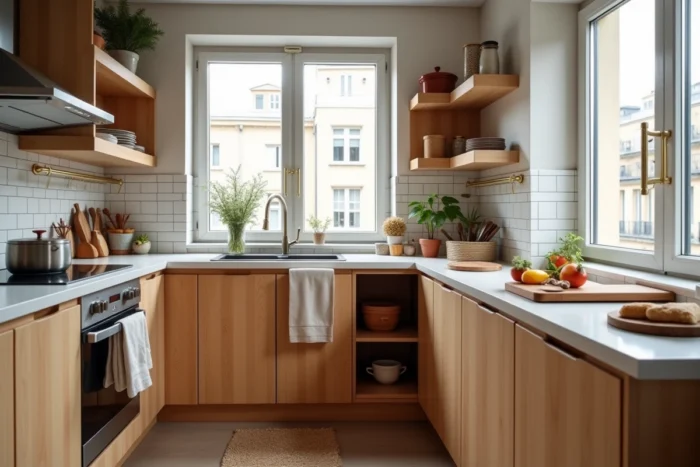
Installing a corner cabinet in a small kitchen makes sense: you reclaim a lost corner and gain storage. However, the actual usable capacity depends on the chosen mechanism, the available dimensions, and what you plan to store there. A poor choice of system can make the corner less accessible than a simple straight cupboard, turning the promised space-saving into dead volume.
Corner Mechanism in the Kitchen: Usable Capacity vs. Actual Bulk
The internal mechanism of the corner cabinet has become the decisive criterion during planning. Two cabinets with identical external dimensions can offer very different storage capacities depending on the system chosen.
| Type of Mechanism | Accessibility | Utilized Usable Capacity | Main Constraint |
|---|---|---|---|
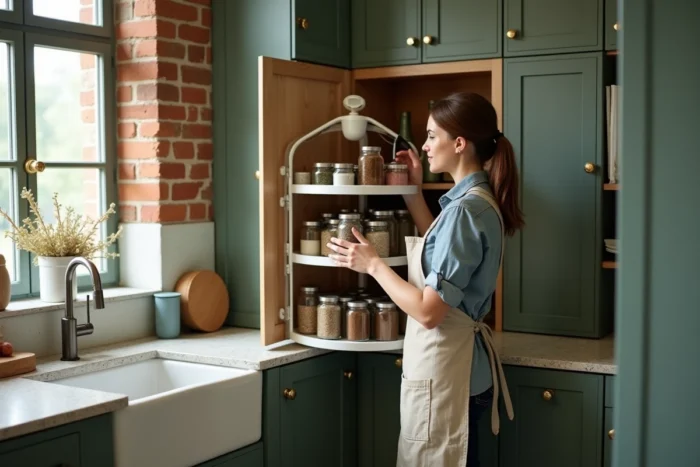
| Rotating carousel (turntable) | Good for items close to the axis | Medium (dead zones at the periphery) | Tall or heavy items slide during rotation |
| Sliding pull-out shelf (Le Mans type) | Very good (fully extends outside the cabinet) | High | Requires sufficient door opening and clearance in front of the cabinet |
| Classic fixed shelves | Poor at the back of the corner | Low (the back remains inaccessible) | Loss of volume beyond the reach of the arm |
| Independent pivoting half-shelves | Good | Medium to high | Higher cost, precise assembly required |
The sliding pull-out shelf offers the best ratio between occupied volume and volume that is actually accessible. However, it requires clearance space in front of the facade, which can be problematic in a kitchen of less than six square meters.
Fixed shelves, often offered in entry-level options, leave the back of the corner almost unusable. Items stored at the back end up forgotten, which means losing the space you were trying to reclaim.
To explore other approaches to storage solutions on Angie Sweet Home, the logic remains the same: prioritize direct access to the contents rather than theoretical volume from a catalog.
Critical Measurements Before Choosing a Kitchen Corner Cabinet
A poorly sized corner cabinet exacerbates the problem it was meant to solve. Three measurements determine the success of the layout.
- Cabinet depth and usable depth: the advertised depth often includes the thickness of the door and the dead zone at the back. The usable depth, where you can actually store items, is always less.
- Door clearance angle: a pull-out shelf needs a door opening of at least 90 degrees. If a wall, refrigerator, or another cabinet blocks the opening halfway, the mechanism becomes unusable.
- Height under the countertop: baskets and interior shelves have standardized heights. Checking that the interior height of the cabinet matches the chosen system avoids discovering, after assembly, that the upper basket rubs against the countertop.
Measuring the floor clearance in front of the corner is also crucial. In a narrow L-shaped kitchen, a person must be able to stand in front of the open cabinet without blocking access to the sink or cooktop.
What to Store (and Not Store) in a Small Kitchen Corner
The debate has evolved: the question is no longer just how to fill the corner, but which items deserve to be stored there. Prioritizing uses in the corner is a practical recommendation that changes the perception of space-saving.
Items Suitable for Corner Storage
Utensils used a few times a week (multi-cooker, casserole, stand mixer) find their place well in a low corner cabinet equipped with a pull-out shelf. Their weight and size justify a dedicated space, and their moderate frequency of use tolerates slightly less direct access than a front drawer.
Food reserves (canned goods, jars, bags of flour) are also good candidates, provided the mechanism allows for a quick glance at what is stored. A rotating carousel works for jars of uniform height.
What Should Not Be Stored in the Corner
Everyday items should not be relegated to a deep corner. Storing plates or glasses used at every meal in a corner cabinet, even a well-equipped one, adds a few seconds to each action. Multiplied by hundreds of repetitions, this detail degrades the overall ergonomics of the kitchen.
Fragile items (fine glassware, handmade ceramics) do not fare well on rotating shelves. The rotation movement causes collisions between pieces, especially if the shelf is unevenly loaded.
Overall Configuration: The Corner Does Not Work Alone
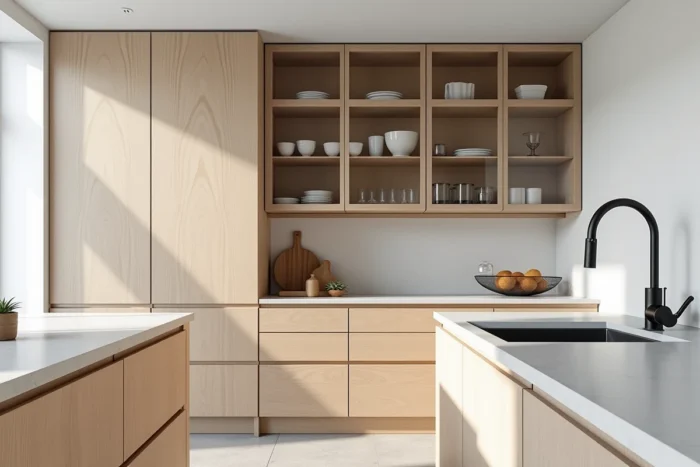
Corner cabinets fit into the overall configuration of the kitchen. A well-equipped corner in a poorly thought-out L-shaped layout does not compensate for a countertop that is too short or inaccessible high cabinets.
In a small kitchen, the logic of zoning takes precedence over filling every nook. Three main zones (cold storage, preparation, cooking) must remain within easy reach. The corner cabinet serves as a junction between two of these zones. If it interrupts the workflow instead of facilitating it, it becomes an obstacle.
The height of high corner cabinets also deserves consideration. A tall corner cabinet with rotating shelves looks appealing on a 3D plan. In reality, reaching the contents of the upper shelves without a step stool remains difficult when the ceiling height exceeds the user’s height by more than fifty centimeters.
A coherent design involves choosing materials and colors that unify the corner cabinets with the rest of the kitchen. A visually distinct corner cabinet (different finish, mismatched handle) draws attention to the weak point of the layout instead of integrating it.
A well-designed corner is one that you forget about in daily use: you open, take, and close without contortion or hesitation. If the corner cabinet requires thought with each opening, the mechanism or the contents need to change.