
Notifying your employer of an absence due to illness may seem simple. However, the message sent has a direct impact on the perception of your seriousness and on the management of your position during your absence. A vague SMS or a clumsy email can create unnecessary tensions. Here are ten examples of messages to notify about your absence from work due to illness, tailored to specific situations.
1. The short SMS to the direct supervisor

You wake up feverish and your shift starts in an hour. SMS remains the fastest channel to notify without delay.
“Hello [First Name], I am unwell this morning and will not be able to come to work today. I will consult my doctor in the morning and keep you informed of the outcome. Best regards.”
Notify before the usual start time. Even though there is no specific legal deadline for a simple message, acting early shows your reliability and gives the team time to organize. This type of wording, found in any good example of an absence message for illness, gets straight to the point without unnecessary medical details.
2. The formal email with estimated return date

When you already know the likely duration of your absence, a structured email reassures your hierarchy.
“Subject: Absence due to illness – expected return on [date]. Hello [Name], following my medical consultation, I am on sick leave from [date] to [date]. My certificate will be sent within 48 hours. I remain reachable by email for any urgent questions related to file handover.”
Be careful on this last point: responding to professional requests during sick leave is not an obligation. The right to disconnect applies, and any active request from the employer during this period engages their responsibility.
3. The message for a short absence without immediate certificate

A medical appointment is not always possible on the same day. Your message should indicate that the justification will follow.
“Hello [First Name], I am unable to work today due to health reasons. I will consult as soon as possible and will send you the medical justification within the required time. Thank you for your understanding.”
This message covers the urgency while signaling your intention to provide the necessary documents. The medical certificate must be sent to the employer within 48 hours.
4. The message intended for human resources
Some companies require a parallel notification to the HR department. The tone is more administrative.
“Subject: Sick leave declaration – [Your name, department]. Dear Sir/Madam, I inform you that I am on sick leave starting [date], for a projected duration of [X] days. My place of rest during this leave is my usual home. The employer’s copy of my leave will be sent to you by mail.”
Since decree n° 2024-692 of July 5, 2024, the employee must communicate their place of rest if it differs from their home. Including this mention in your message to HR anticipates any additional requests.
5. The SMS for extending sick leave

Your initial sick leave is coming to an end, but your doctor extends it. You need to notify without delay.
“Hello [First Name], my doctor has extended my sick leave until [new date]. The extension certificate will be sent today. I will keep you informed of any developments.”
Stay factual. There’s no need to justify your health condition: you have no obligation to detail your illness to your employer.
6. The message with urgent file handover
When you manage sensitive files, a sentence about continuity of activity makes all the difference.
“Hello [First Name], I am on sick leave starting today. The [project name] file can be followed by [colleague], who has the necessary access and context. My sick leave will be sent to you within 48 hours.”
Offering an operational relay shows your sense of responsibility, even from home. Limit yourself to this indication, without managing the project remotely.
7. The absence email for illness addressed to a client

Informing a client requires a different tone. No medical details, but a clear replacement solution.
“Subject: Temporary absence – your contact during this period. Hello [Client Name], I am currently unavailable due to health reasons. During my absence, [colleague] will take over your file. You can reach them at [email/phone]. I will get back to you as soon as I return, expected on [date].”
With a client, the goal is to ensure continuity of service without exposing your private life.
8. The automatic absence message (out of office)
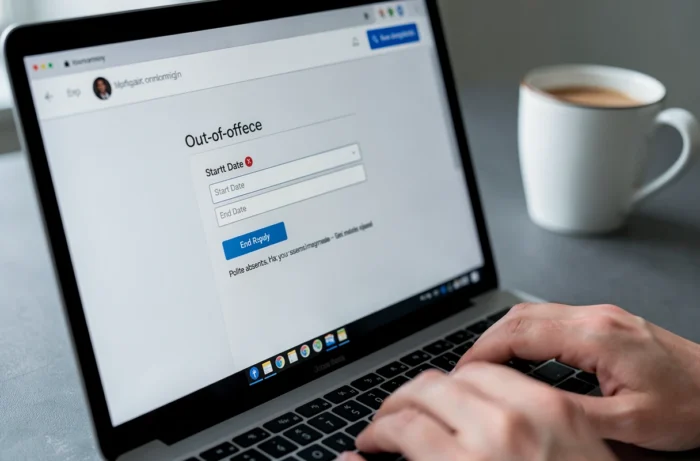
If your absence lasts several days, set up an automatic reply on your professional email.
“Hello, I am currently absent and unable to respond to your messages. For any urgent requests, please contact [Name] at [email address]. I will review your message upon my return, expected on [date].”
- Do not mention the word “illness” in an automatic message: a simple “absent” is sufficient for a broad send.
- Indicate only one contact person, not three, to avoid confusion.
- Specify the return date if known; otherwise, write “as soon as possible.”
9. The message in case of unexpected hospitalization
Sometimes, a relative notifies on your behalf. The message should be brief and contain only the essential information.
“Hello, I am contacting you on behalf of [First Name Last Name]. He/She has been hospitalized since this morning and cannot reach you directly. A work leave will be sent to you as soon as possible. For any questions, you can call me at this number.”
This scenario is more common than one might think. If you have managerial responsibilities, consider leaving the contact details of a trusted relative with your HR team.
10. The message of return after a prolonged absence

Returning to work after a long absence also deserves a message. It re-establishes the professional link and smooths the transition.
“Hello [First Name/team], I am resuming my position as of [date]. I am available for a status update on ongoing files. Thank you for your support during my absence.”
This message is not mandatory, but it facilitates the transition. After an absence of more than 30 days, a return visit to the occupational doctor is mandatory before or within the days following your effective return.
Each situation of absence due to illness calls for a message tailored to the recipient and the context. The common point between these ten examples: remain factual, convey useful information, and respect notification deadlines. A good message protects both your professional image and your rights as an employee.