
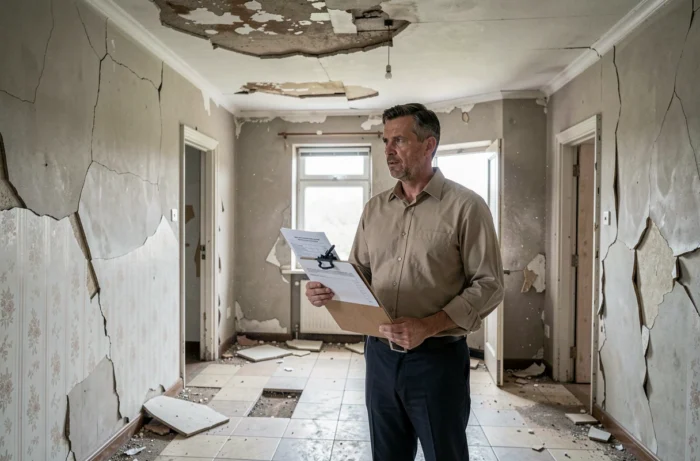
Water damage has ravaged the roof, the load-bearing walls are cracked, and the electricity has been cut off for months: the housing is objectively uninhabitable, yet the property tax notice still arrives. To obtain a tax reduction, one must understand what the administration actually considers as unfit for occupation, and above all, gather evidence before drafting anything.
Uninhabitable housing in the eyes of the tax authorities: the technical dividing line
It is often thought that an empty property is enough to obtain a tax reduction. In reality, the tax services and administrative courts draw a clear line between comfort renovations and structural degradation.
A property undergoing refreshing (painting, replacing floors, installing a kitchen) remains taxable. Judges consider that these interventions do not render the housing uninhabitable. Conversely, the absence of water, sanitation, or electricity is a determining criterion, just like the partial collapse of the roof or the weakening of the load-bearing structure.
Responses on this point vary according to tax centers, but recent case law converges: it is the structural nature of the work that shifts a case towards tax reduction. A property subject to a declaration of unsanitary conditions or a disaster making occupation dangerous falls into this category. A property that is simply uncomfortable does not.
Declaration of occupation on impots.gouv.fr: report the vacancy of the property
Before requesting a tax reduction, one must update the occupancy status of the housing in the “Real Estate” section on impots.gouv.fr. To understand the procedures with the tax authorities for an uninhabitable house, it is important to know that since the abolition of the housing tax on primary residences, this declaration of occupancy has become the mandatory entry point for any change.
The online process offers several reasons for vacancy. For an uninhabitable house, select “uninhabitable premises (unsanitary housing)”. The form then asks for the date when the property became unoccupied. This date is crucial: it conditions the calculation of the tax reduction and the potential application of the vacant housing tax.
If a change in occupancy occurs between January 2 and January 1 of the following year, the declaration must be made before July 1. Failing to do so risks receiving a notice of housing tax on vacant housing (THLV) or vacant housing tax (TLV), depending on the municipality.
Documents to gather before declaring
The online declaration is not sufficient to obtain a tax reduction. A solid evidence file must be compiled. Here are the elements that truly weigh in the assessment:
- A bailiff’s report or an expert’s report describing the condition of the building (structure, networks, roofing), dated and detailed
- A municipal order of unsanitary conditions or danger, if the municipality has issued one, which officially establishes the uninhabitable nature
- Invoices or estimates for structural work (framework, load-bearing walls, foundation repairs) showing that the interventions exceed simple maintenance
- Timestamps photos of the interior and exterior, showing the absence of important comfort elements or the damage
- The insurer’s report in case of a disaster (fire, flooding, major water damage)
Without these documents, the claim risks rejection. The tax services do not grant reductions based on a simple declaration.
Claiming a property tax reduction: drafting and sending the request
Once the occupancy declaration has been updated and the evidence gathered, one proceeds to the actual claim. The property tax reduction is requested through a contentious claim, either online via the secure messaging system in the personal space on impots.gouv.fr, or by registered mail addressed to the property tax center responsible for the property.
The request must mention the cadastral reference of the property, the period of uninhabitation (start date, end date if the work is completed), and the specific reason. All supporting documents must be attached.
Claim deadline and calculation of the tax reduction
The claim can be submitted until December 31 of the year following the year the property tax is levied. Specifically, for a notice received in the fall, one has more than a year to act.
The reduction is calculated pro-rata based on the duration of uninhabitation, starting from the first day of the month following the start of the vacancy. If the house is uninhabitable from March 15 to November 30, the reduction covers the period from April to November.

TLV and THLV: avoiding the vacant housing tax when the property is uninhabitable
An uninhabitable house can also be subject to the vacant housing tax (TLV) or the housing tax on vacant housing (THLV). In tense areas, the TLV applies from the first year of vacancy, with a rate that significantly increases from the second year.
To be exempted, it must be demonstrated that the vacancy is not voluntary but results from an external cause beyond the owner’s control. A major disaster, structural work rendering the housing unfit for habitation, or a declaration of unsanitary conditions fall into this category. The same evidence as for the property tax reduction is used here.
The nuance to remember: “normal” renovation work (even if costly) is not sufficient if the housing remains technically habitable. It is the danger or physical impossibility of occupying the premises that justifies the exemption.
Check the applicable regime for your municipality
Not all municipalities are subject to the same rules. The simulator available on service-public.fr allows you to check if a property is located in a TLV zone. In municipalities outside tense zones, only the THLV may apply, but only if the local authority has deliberated in this sense.
Building a complete file from the very beginning of the vacancy remains the best protection. An owner who waits for the tax notice to react loses time and weakens their position. Gathering evidence on the same day as the disaster or the declaration of uninhabitation facilitates every step, from the occupancy declaration to the tax reduction claim.