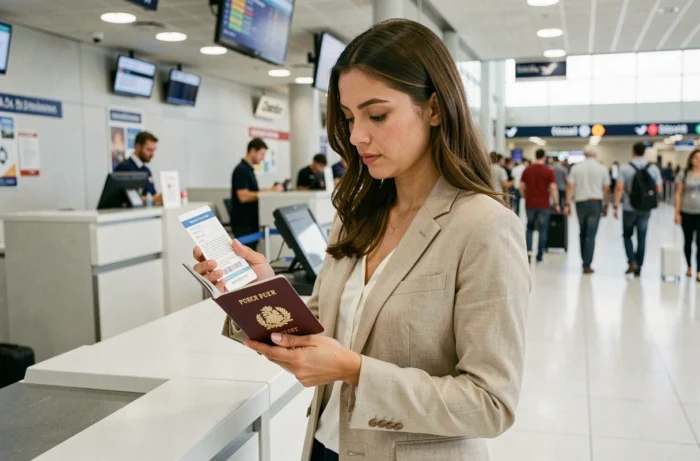
On a French passport, the “first names” section often lists two, three, or sometimes four first names. The flight booking form, however, typically offers a single field labeled “first name.” This discrepancy between the identity document and the plane ticket raises a recurring question: should one enter their second first name during booking to avoid being denied boarding?
Ticket-passport concordance: what agents really check
The check at check-in and boarding gates is based on a simple principle: the name on the ticket must match the identity document. Agents compare the last name and the first first name. When these two elements match, the passenger passes through without difficulty, even if the second first name is absent from the ticket.
The majority of airlines apply this tolerance because their reservation systems (GDS) have long formatted names restrictively, sometimes concatenating all first names into a single field or truncating characters beyond a certain limit. Therefore, the absence of an additional first name is not treated as an identity discrepancy.
On the other hand, a misspelled first name, an incomplete last name, or a name/first name inversion poses a real problem. The question of the usefulness of the second first name on the ticket is often resolved with a brief answer: it is not mandatory for most flights, as long as the first name and last name are correct.

Second first name on plane ticket: situations where omitting it may cause problems
If the general rule is tolerant, certain situations make adding the second first name more prudent, even necessary.
Destinations with strict APIS data checks
Several countries require the transmission of APIS (Advance Passenger Information System) data before takeoff. This data is automatically compared to the passport information stored in border control databases. A discrepancy between the ticket and the passport can trigger an alert, even for a simple missing first name.
Flights to the United States are the most frequently cited. The TSA (Transportation Security Administration) system cross-references the full names on the passport with those on the ticket. An absent second first name does not systematically block boarding, but an intermediate name that appears on the passport and not on the reservation can slow down the process or generate additional checks.
Namesakes and very common first names
When a traveler has a common last name and first name (Jean Martin, Mohamed Ali), the second first name serves as a distinguishing factor. Without it, matching with a watchlist or another passenger can create confusion. Adding the second first name reduces this risk.
Airlines that fill out the field differently
Some low-cost airlines offer a single “first name” field without specifying whether all first names should be included. Others, like Gulf or Asian airlines, display a distinct “middle name” field. When a dedicated field for the second first name exists, filling it out avoids any ambiguity.
Correcting first name after booking: procedures and limits
Forgetting the second first name at the time of booking is classified by most airlines as a minor correction, similar to a typo of a few letters. In recent years, several major networks have formalized “name correction” policies that clearly distinguish this type of adjustment from a passenger change.
- At American Airlines, adding a missing first name to align the ticket with the passport falls into the category of minor corrections and does not trigger penalty fees, as long as the person remains the same.
- Airlines in the Lufthansa group apply a similar logic: adding or correcting a first name does not change the ticket pricing.
- European low-cost airlines (EasyJet, Ryanair) generally allow a name correction for a fixed fee, but the boundary between correction and name change varies according to their general conditions.
Contacting customer service or modifying the reservation online remains the most direct method. A call before the day of departure is sufficient in the vast majority of cases.
Compound names, hyphens, and particles: input traps that matter more
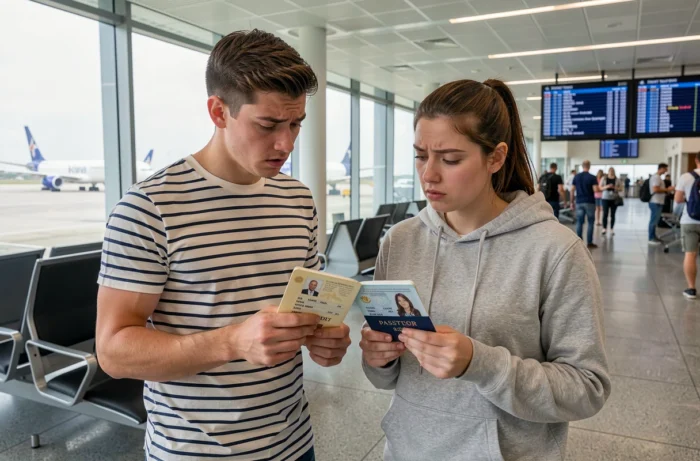
The second first name draws attention, but the most penalizing errors concern other elements of the name. A forgotten hyphen in a compound first name (Jean-Pierre entered as Jeanpierre), an omitted particle (de, du, le), or a miswritten accent create discrepancies that automated systems detect more easily than a missing first name.
The French passport lists first names in the order of civil status, separated by spaces. Reproducing the exact spelling from the passport in the first name field of the reservation remains the most reliable reflex. If the field does not accept accents or hyphens, removing them generally poses no problem, as control systems normalize these characters.
Last names with particles deserve special attention. “De la Fontaine” can be interpreted as a last name “Fontaine” with a prefix, or as an indivisible block. Checking the machine-readable zone (MRZ) of the passport, located at the bottom of the identity page, allows you to know exactly how the name is coded in international systems.
When to enter all your first names on a plane ticket
Three situations justify entering all first names during booking:
- The airline’s form displays a distinct “middle name” or “other given names” field separate from the “first name” field.
- The destination requires APIS transmission with strict matching (transatlantic flights, certain countries in Asia or the Middle East).
- The traveler has a very common last name and first name, which increases the risk of confusion with a namesake.
Outside of these cases, the exact first name and last name are sufficient for traveling without difficulty. The second first name remains an optional element on most reservations, and its absence does not constitute a reason for denial of boarding with major European and North American airlines.
The only truly decisive precaution is to check, before confirming the reservation, that each letter of the first name and last name matches exactly what is on the passport or identity card used for travel.