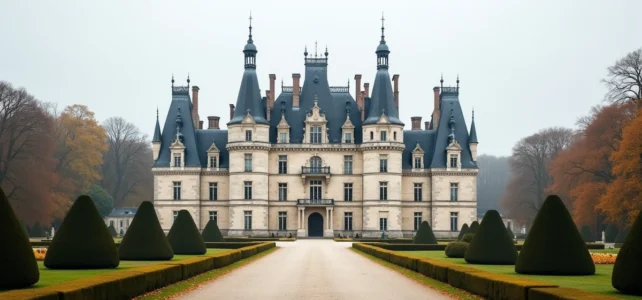
The Château de Chambord does not appear on any balance sheet of the French state. No official value is assigned to it, making any estimation purely theoretical. Insurers, however, suggest amounts exceeding one billion euros, and the parameters used for any modeling can significantly vary the result.
Why the Château de Chambord Escapes Traditional Valuation Methods
In residential or commercial real estate, the value of a property is based on comparables: recent transactions involving similar properties within a given geographical area. For Chambord, no comparable exists on the market. A domain of this scale, housing 440 rooms and 365 fireplaces, resembles nothing else in Europe.
The estimation based on reconstruction costs faces a similar obstacle. The skills required to carve tuff stone using Renaissance techniques or to reproduce the double spiral staircase attributed to Leonardo da Vinci have no industrial equivalent.
Current restoration estimates provide a partial idea: the renovation of the François Iᵉʳ wing alone requires an estimated budget of 37 million euros. Extrapolating this cost to the entire monument would mean multiplying this figure by a considerable factor, without even including the value of the land or the intangible heritage.
When trying to understand the estimated value of the Château de Chambord, one must accept that the usual tools of real estate expertise simply do not work.
Tourist Flow and Revenue: The Measurable Economic Value of Chambord
While the heritage value remains theoretical, the economic value of the castle can be measured more concretely. Chambord welcomed 1.22 million visitors in 2025, a historical record. This flow generates direct ticketing revenue, as well as ancillary income related to parking, the rental of golf carts and boats, and the sale of wine produced on the estate.
This ratio between revenue and theoretical value remains very low compared to a traditional real estate asset, reflecting the very nature of the monument: Chambord is not a rental investment but a sovereign asset.
What Tourist Revenues Do Not Cover
Operating revenues are not enough to finance the conservation of the site. A ten-year renovation campaign estimated at 100 million euros has been announced, which is about 10 million euros per year. Funding relies on a combination of the castle’s own funds, state credits, and sponsorship.
This dependence on external funding weighs heavily in any serious estimation. An asset that requires regular injections of public and private capital to maintain its physical integrity sees its theoretical net value diminished by these recurring costs.
The Parameters That Affect the Estimation of Chambord
The gap between low and high estimates is considerable. It is explained by the relative weight assigned to each parameter in the calculation.
- The real estate and land base: 14,000 m² of living space and a vast enclosed forested area form the foundation. The price per square meter of historical built heritage and the forest value constitute the starting point for any modeling.
- The rarity and prestige premium: UNESCO World Heritage status under the Loire Valley, partial attribution to Leonardo da Vinci. These elements significantly drive the value upwards.
- The operating flow: the site’s ability to generate over a million paid visits per year is a positive factor, but its weight remains modest in the overall estimation.
- Regulatory constraints: the impossibility of modifying, selling, or freely exploiting a classified monument mechanically reduces its value and applies a substantial discount to any estimation.

The Paradox of an Asset Whose Constraints Create Value
The restrictions placed on Chambord (prohibition of transformation, conservation obligations, state control) are the same that guarantee its authenticity and thus its heritage value. Removing the constraints would mean destroying what gives the monument its worth. This circle radically distinguishes heritage properties from traditional real estate assets, where freedom of use increases value.
Chambord on the State’s Balance Sheet: A Public Treasure Outside Accounting
The absence of Chambord from the state’s valued assets is not an oversight. French public accounting rules do not allow for the inclusion of historical monuments whose sale is neither contemplated nor feasible. This choice has a direct consequence: no public institution produces an official estimate.
The only available figures come from insurers, independent modeling, or editorial projections. Any amount put forward remains an intellectual construct, not a price at which anyone could buy or sell the monument.
The question of Chambord’s value will likely never find a definitive answer. The monument is worth exactly what the national community is willing to spend each year to keep it standing, which is at least 10 million euros per year at the current pace of scheduled works.